Stef Craps
Ghent University
Publications
Filter by type:
Fragment 95 and commentary for hand-written lockdown edition of Max Havelaar by Multatuli
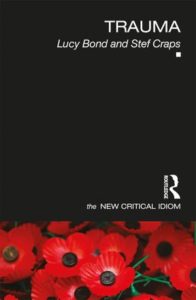
Trauma
Trauma has become a catchword of our time and a central category in contemporary theory and criticism. In this illuminating and accessible volume, Lucy Bond and Stef Craps:
- provide an account of the history of the concept of trauma from the late nineteenth century to the present day
- examine debates around the term in their historical and cultural contexts
- trace the origins and growth of literary trauma theory
- introduce the reader to key thinkers in the field
- explore important issues and tensions in the study of trauma as a cultural phenomenon
- outline and assess recent critiques and revisions of cultural trauma research
Trauma is an essential guide to a rich and vibrant area of literary and cultural inquiry.
Lucy Bond is a principal lecturer in English literature at the University of Westminster, UK.
Stef Craps is a professor of English literature at Ghent University, Belgium.
Reviews:
This book by Lucy Bond and Stef Craps highlights the discourse on trauma. Trauma is regarded as the most intricate, pervasive, severe, and repressed psychological scar that results from terrible experiences in life. It remains unresolved for decades, and generations, which recurs through nightmares, hallucinations, and flashbacks. . . . In conclusion, trauma is a universal and complex thing to be understood in today’s 21st century. With the verge of time, trauma employs various meanings which range from physical to psychological injuries. The evolution of trauma itself has a huge history and asserts cultural relevance in the public sphere. Studying the realms of trauma in an extensional way reflects the new method of analyzing trauma.
Ishani Ipsita Patel and Devendra Kumar Sharma, Social Identities (29.6 (2023))
De maneira geral, a obra é bem-sucedida em seu intento de delinear a trajetória histórica dos estudos de trauma e sua aplicação na análise literária e em outros meios de produção artística e cultural. Fatos históricos, pesquisadores, obras, estudos e termos mais importantes para o desenvolvimento do campo são apresentados ao leitor em linguagem clara e sucinta. Essa é, certamente, uma obra de referência e consulta rápida, útil para o pesquisador mais experiente, ao mesmo tempo que funciona como material introdutório de fácil acesso e entendimento para estudantes iniciantes na área. Nesse sentido, o livro cumpre sua pretendida e anunciada função de manual ou de guia, já que explora todos os momentos e temas mais relevantes para os estudos de trauma, sem deixar de suscitar reflexões sobre o tema.
Joyce Silva Fernandes, Remate de Males (41.1 (2021): 295-98)
As an introduction to trauma theory and its applications to contemporary literary, artistic, and clinical work, the volume sets a high standard. It reminds us of the limitations of trauma studies as a dominant paradigm and exposes its controversies, while endeavoring to enlarge our understanding of this huge field. Trauma will be useful as an introduction for students who struggle with omnipresent and often confusing conceptions of trauma, but professionals and scholars could equally benefit from reading through its dense but clear summaries of a vast array of sources. I recommend the book whole-heartedly to anyone with an interest or need to gain greater familiarity with the meaning and pervasiveness of trauma at this moment of history.
Lewis Kirshner, American Imago (77.4 (2020): 800-08)
Contents:
Acknowledgements
Series Editor’s Preface
1. The History of Trauma
The Origins of Hysteria
Invisible Wounds of War
An Integrated Approach
The Age of Trauma
2. Words for Wounds
Poetry after Auschwitz
Shifting Paradigms
Caruth’s Unclaimed Experience
Hartman’s Traumatic Knowledge
Felman and Laub’s Crises of Witnessing
3. Trauma Theories
Acting-Out and Working-Through
Historical and Structural Trauma
Transgenerational Trauma
Fantasies of Witnessing
Individual and Collective Trauma
4. The Future of Trauma
Decolonizing Trauma
Beyond the Trauma Canon
Perpetrator Trauma
The Trauma of the Future
Conclusion: The Limits of Trauma
Glossary
Bibliography
Index

Traag geweld: Kan kunst het klimaat redden?
Inleiding: Traag geweld: Kan kunst het klimaat redden?
Stef Craps en Mahlu Mertens
Gesprek met Nic Balthazar: “De verzoenbaarheid van kunst en activisme”
Stef Craps en Mahlu Mertens
Gesprek met Moya De Feyter: “Hoop is gewoon hard werken”
Stef Craps en Mahlu Mertens
Gesprek met Alexander Devriendt: “Het onmogelijke mogelijk maken”
Stef Craps en Mahlu Mertens
Gesprek met Christel Stalpaert: “De slagkracht van de verbindingsstreepjes”
Stef Craps en Mahlu Mertens
Poëtisch verzet tegen de teloorgang van de natuur
Leestip: Verloren woorden van Robert Macfarlane en Jackie Morris, vertaald door Bibi Dumon Tak.
Introduction: Ecological Grief
Introduction: Decolonizing English Literature
Inleiding: Traag geweld: Kan kunst het klimaat redden?
Grief as a Doorway to Love: An Interview with Chris Jordan
Gesprek met Nic Balthazar: "De verzoenbaarheid van kunst en activisme"
Gesprek met Moya De Feyter: "Hoop is gewoon hard werken"
Gesprek met Christel Stalpaert: "De slagkracht van de verbindingsstreepjes"
Gesprek met Alexander Devriendt: "Het onmogelijke mogelijk maken"
Flooded Cities in Low Countries Fiction: Referentiality and Indeterminate Allegory in Renate Dorrestein’s Weerwater and Roderik Six’s Vloed
In a range of environmentally oriented international novels, future cities in the Low Countries have been flooded, with Dutch populations relocated to higher grounds or to floating cities. In contemporary Dutch and Flemish fiction, however, reflections on cities by the water are few and far between. More conspicuously, in the few literary novels that imagine cities under threat from rising water levels, the cities in question are not located on the shore but further inland, gesturing towards other meanings and symbolical repercussions rather than towards an engagement with flooding per se. This article examines two contemporary flood novels: Roderik Six’s Vloed (“Flood”) and Renate Dorrestein’s Weerwater. We approach the floods in these novels in terms of indeterminate allegory, examining the contradictory meanings that can be attributed to the radical upheavals recounted in these narratives.
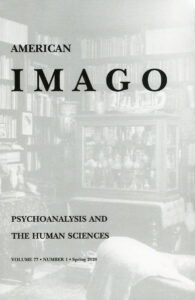
Ecological Grief
Introduction
Introduction: Ecological Grief
Stef Craps
Theorizations
Negating Solastalgia: An Emotional Revolution from the Anthropocene to the Symbiocene
Glenn A. Albrecht
“You can never replace the caribou”: Inuit Experiences of Ecological Grief from Caribou Declines
Ashlee Cunsolo, David Borish, Sherilee L. Harper, Jamie Snook, Inez Shiwak, Michele Wood, and the HERD Caribou Project Steering Committee
Ecological Grief and Anthropocene Horror
Timothy Clark
Is Climate-Related Pre-Traumatic Stress Syndrome a Real Condition?
E. Ann Kaplan
Planet Earth: Crumbling Metaphysical Illusion
Robert D. Stolorow
Mediations
Grief as a Doorway to Love: An Interview with Chris Jordan
Stef Craps and Ida Marie Olsen
There Is Grief of a Tree
Paul K. Saint-Amour
Anthropocenic Affects and Ethics in Aaron Thier’s Mr. Eternity
Mahlu Mertens
“His sickness was only part of something larger”: Slow Trauma and Climate Change in Leslie Marmon Silko’s Ceremony
Martin Premoli
Petromelancholia and the Energopolitical Violence of Settler Colonialism in Waubgeshig Rice’s Moon of the Crusted Snow
Reuben Martens
Review Essays
Review of Earth Emotions: New Words for a New World by Glenn A. Albrecht
Ben De Bruyn
Review of Affective Ecocriticism: Emotion, Embodiment, Environment, edited by Kyle Bladow and Jennifer Ladino
Shannon Lambert
Review of Mourning Nature: Hope at the Heart of Ecological Loss and Grief, edited by Ashlee Cunsolo and Karen Landman
Rick Crownshaw
Contributors
Decolonizing English Literature
Introduction: Decolonizing English Literature
Stef Craps
Ankhi Mukherjee
Dévoiler les ténèbres de Conrad: à propos de l’oeuvre spectrale de Michael Matthys
Une interview par Véronique Bragard
Decolonizing the Cli-Fi Corpus
Mahlu Mertens and Gry Ulstein
“A Sense of Being the Foreign-”: Unlearning Western Privilege in J. T. Rogers’s The Overwhelming
Laura Michiels
Climate Trauma
The increasing visibility of climate change and scientists’ alarming warnings about it are taking a toll on people’s mental well-being. This essay surveys the culturally resonant repertoire of new coinages that have emerged in recent years to name and communicate environmentally induced distress. It pays particular attention to the concept of pre-traumatic stress disorder, which has become the focus of a small but important body of humanistic scholarschip calling for an expanded trauma theory that would be future- as well as past-oriented. Noting trauma theory’s persistent human-centredness, the essay goes on to consider attempts that are being made to reconceptualize trauma in non-anthropocentric terms and to acknowledge the interconnectedness and entanglement of human and non-human traumas. It ends by predicting that cultural trauma research, which has so far shown relatively little interest in environmental issues in general and climate change in particular, will engage more fully with our dire environmental predicament in the years ahead.
Tracing Transnational Memory: From Celebration to Critique
In recent years, scholarship on transnational or transcultural memory has become more clear-eyed about the limitations of remembering across national or cultural boundaries. The initial euphoria has dampened: critics these days are more likely to draw attention to factors that impede the flows of memory than to naïvely celebrate mnemonic mobility. Even so, contemporary memory research holds on to the ethical potential of transnational and transcultural paradigms of remembrance.
Récemment, la recherche sur la mémoire transnationale ou transculturelle est devenue plus lucide quant aux limites de la mémoire au-delà des frontières nationales ou culturelles. L’euphorie initiale s’est estompée: les critiques de nos jours sont plus susceptibles d’attirer l’attention sur les facteurs qui entravent les flux de mémoire que de célébrer naïvement la mobilité mémorielle. Toutefois, la recherche contemporaine sur la mémoire conserve le potentiel éthique des paradigmes mémoriels transnationaux et transculturels.
Towards an Understanding of Drone Fiction
Since the end of the twentieth century, strike-capable military drones have rapidly evolved from an ominous near-future technology, seldom discussed outside of science fiction or top-secret military contexts, to a burgeoning multi-billion dollar international industry at the centre of public scrutiny and interest. Meanwhile, the figure of the drone has saturated Western public consciousness to the point that it can be described as a trope. Sparking the interest of artists, writers, and filmmakers, drone warfare has begun to feature in a wide range of films, books, and art installations, and this flood of drone-related media seems unlikely to peter out. To date, however, little academic work has looked in depth at cultural interpretations of drones and the role they serve in fictional(ized) narratives. What is urgently needed to better our understanding of the drone, we argue, is a cultural studies perspective that is able to assess the drone as a fictional, narrative construct, while still taking account of its very real, material consequences for both pilots and victims. This article aims to introduce readers to the nascent field of drone fiction, providing a jumping-off point for future research into the figure of the drone. Here, we explore how drone warfare is mediated through three different drone-fictional works: the semi-autobiographical book The Drone Eats with Me by Atef Abu Saif, the experimental video game Unmanned by Molleindustria, and the short film 5,000 Feet Is the Best by Omer Fast. Through close readings of these varied works, we draw attention to what each particular mode of mediation reveals about the effects of drones on those who work with or live around them.
Testimony for #WeChangeForLife
Op wandel met Guido in Leuven, Gent en Ieper
Last Aboriginal Person Standing in a Climate-Changed Australia: A Conversation with Alexis Wright
Klimaatfictie in de Lage Landen?
Met het water al bijna aan de lippen vragen Stef Craps en Mahlu Mertens zich af of de klimaatopwarming Nederlandstalige fictieschrijvers niet een beetje te koud laat.
Jeff Nichols's Take Shelter (2011): Psychic Cli-Fi
This essay gives an overview of the central themes and formal features of Jeff Nichols’s cli-fi film Take Shelter (2011). It also provides insight into the film’s reception and contribution to public debate, as well as offering some teaching ideas.
Beyond Identification in Human Rights Culture: Voice of Witness’s Voices from the Storm and Dave Eggers’s Zeitoun
In this article, we analyse two testimonial narratives written or published by Dave Eggers, an American author, editor, and publisher whose oeuvre shows a marked interest in harnessing the power of narrative to engage in human rights activism. Both narratives focus on the case of Abdulrahman Zeitoun, a Syrian-American who suffered in the aftermath of Hurricane Katrina and at the hands of the state through its response to that natural disaster. Our analysis challenges many of the assumptions with regard to affect that dominate the field of human rights and literature, which often takes for granted the intricate and treacherous process that undergirds a reader’s engagement with testimonial narratives. Affective engagement with the reader is a key feature of Eggers’s works, yet we show how it operates in a way that actively shapes the affective tenets of human rights culture in order to allow the reader to engage with the disempowered on more equal terms.
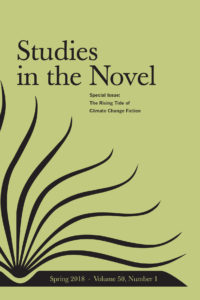
The Rising Tide of Climate Change Fiction
Introduction: The Rising Tide of Climate Change Fiction
Stef Craps and Rick Crownshaw
Beauty That Must Die: Station Eleven, Climate Change Fiction, and the Life of Form
Pieter Vermeulen
The Rest Is Silence: Postmodern and Postcolonial Possibilities in Climate Change Fiction
Adeline Johns-Putra
The Hot War: Climate, Security, Fiction
Ben De Bruyn
Tearing Down the Greenhouse: Visual Ecology, Savvy Critics, and Climate Change in T. C. Boyle’s The Terranauts
River Ramuglia
From the Grotesque to Nuclear-Age Precedents: The Modes and Meanings of Cli-fi Humor
Courtney Traub
The Novel after Nature, Nature after the Novel: Richard Jefferies’s Anthropocene Romance
Jesse Oak Taylor
Contemporary Fiction vs. the Challenge of Imagining the Timescale of Climate Change
Mahlu Mertens and Stef Craps
Cli-fi, Petroculture, and the Environmental Humanities: An Interview with Stephanie LeMenager
River Ramuglia
Contributors
Samuel Beckett, Eindspel
Memory Studies Goes Planetary: An Interview with Stef Craps
Memory Studies and the Anthropocene: A Roundtable
The essays gathered here are slightly revised versions of the position papers presented as part of the roundtable on “Memory Studies and the Anthropocene” at the MLA Convention in Philadelphia in January 2017. What sparked this roundtable is the increasing currency of the Anthropocene, on the one hand, and the observation that the field of memory studies has lately begun to grapple with its implications in earnest, on the other. The participants, all of them leading scholars in the fields of memory studies and/or the environmental humanities, had been asked to respond to the following questions: “What are the implications of the notion of the Anthropocene for memory studies? How, if at all, does the awareness of living in a new geological epoch defined by the actions of human beings affect the objects of memory, the scales of remembrance, and the field’s humanist underpinnings?”
Introduction: The Rising Tide of Climate Change Fiction
The call for papers for this collection on “The Rising Tide of Climate Change Fiction” arose from concerns about pessimistic assessments, in recent literary criticism, of the novel’s ability to meet the representational challenges posed by the pressing planetary problem of climate change. The contributions to this volume take issue with that pessimism and take stock of the novel’s capabilities.
De verbeelding van het Antropoceen
Het Antropoceen is geen puur geologische aangelegenheid. Het concept mag dan wel uit de koker van “harde” wetenschappers zijn ontsproten; het zorgt ook voor grote bedrijvigheid bij “zachte” wetenschappers en cultuurmakers. Zij worstelen met de morele en existentiële vragen die het tijdperk van de mens oproept.